Rabbi Moshe Pitchon
An existential philosopher focused on how we respond
when reality addresses us.
Rabbi Moshe Pitchon has served as a rabbi in Conservative congregations in the United States and South America and has taught Jewish philosophy and biblical literature at universities across both regions.
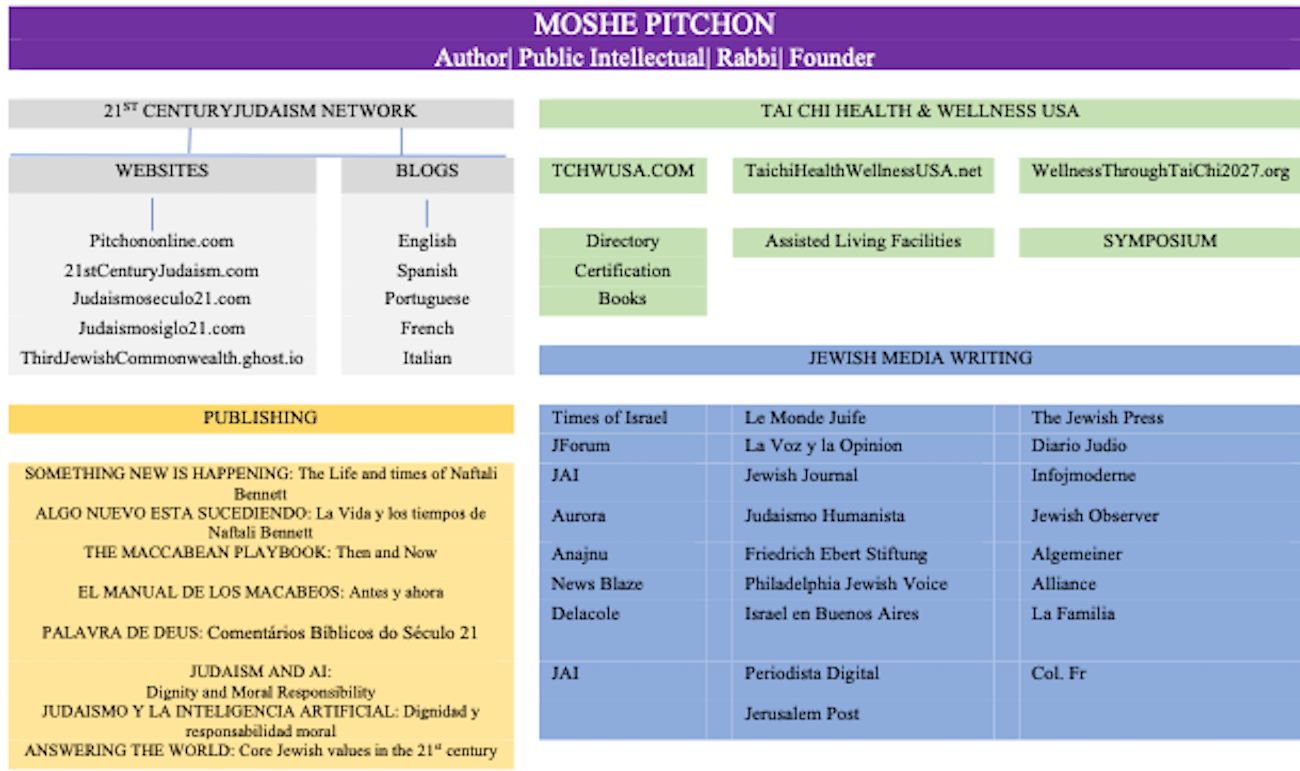
He is the author of several books published in English and translated into Spanish and Portuguese, and his writing appears regularly in Jewish media worldwide.
His approach to Judaism understands it as a discipline of response—an accumulated body of ways of answering the tensions, uncertainties, and responsibilities of life. Not as an abstract system of beliefs, but as a way of thinking and acting when something is at stake.
We are always addressed.
The question is whether we are capable of answering.
Why This Matters Today
In the 21st century, this question has become more urgent.
The power to act—technological, political, and social—moves faster than our capacity to understand. Decisions are made before they are fully thought. Responsibility becomes diffused.
The ability to respond is weakened precisely when it is most needed.
This is the context in which his work takes place
Work & Teaching
His work extends across teaching, writing, and public engagement.
Rabbi Moshe Pitchon has taught Jewish philosophy and biblical literature in both academic and communal settings across the United States and Latin America.
His work includes public lectures, courses, and written analysis addressing contemporary questions through the lens of Jewish thought.
His teaching focuses on developing the capacity for clear thinking under conditions of complexity, where inherited frameworks must be brought into direct engagement with present realities.
contact@pitchononline.com
© 2025. Moshe Pitchon. All rights reserved.