Literature as Humanity’s Memory
The function of literature in human life
LITERATURE
Moshe Pitchon
5/16/20263 min read
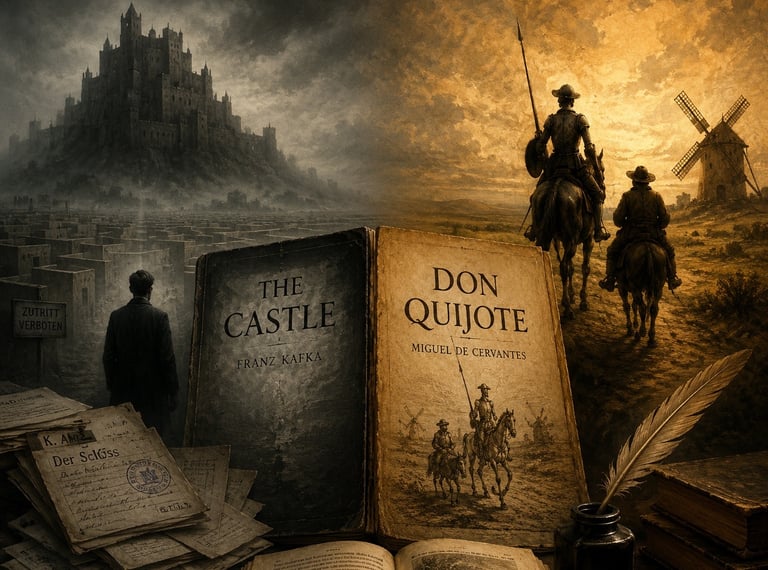
Speaking recently with a teenager attending an elite school, I asked what she was studying and whether she had ever heard of Don Quijote. Without missing a beat, she replied, “Of course—it’s a popular store in Japan.”
Taken aback (I had no idea there was a Japanese store named Don Quijote), I posed the same question to a couple of people in their forties. I received the same answer.
After days of relaying messages between offices on which my health ultimately depended — without getting any closer to solving the problems the system itself had created — I found myself asking the office manager and assistant at my primary doctor’s office whether they had ever read Franz Kafka’s The Castle. Both looked at me in surprise and asked, “Who is Franz Kafka?”
Written in the 1920s Kafka’s The Castle can certainly be read as a profound existential—even theological—allegory. But it is also one of the most penetrating indictments ever written of what bureaucracy does to human life.
Long before automated phone systems, institutional fragmentation, and algorithmic decision-making, Kafka understood the psychological experience of entering systems in which responsibility becomes impossible to locate and human beings become trapped inside procedures that nobody fully controls.
Likewise, Miguel de Cervantes’s Don Quijote, written at the beginning of the seventeenth century, is not merely an old Spanish novel. It explores identity formation, ideological obsession, self-delusion, and the human need for meaning.
Centuries before social media, political branding, and algorithmically reinforced identities, Cervantes understood how human beings construct narratives powerful enough to distort reality itself.
Kafka and Cervantes are not simply “old authors” among others of their caliber; they are intellectual instruments for interpreting the present.
What is at stake is not merely that younger generations—or educational systems themselves—no longer pay attention to classical literature. More troubling is the degree to which contemporary society has detached itself from history, from the long cultural conversation through which human beings once tried to understand power, suffering, illusion, responsibility, and the structure of life.
The importance of classical literature is that it preserves humanity’s memory of itself.
The concept of “classic” recognizes enduring excellence. Think, among others, about classical music, classic films, classic cars, classic rock, and yes, the “Classics” section of a bookstore. “Classic” does not simply mean something old. It refers to something that has endured because generations have continued to find in it a lasting standard of insight, beauty, or truth.
A work becomes a classic when human beings repeatedly discover themselves inside it.
As the late professor of post-biblical Hebrew literature at the University of Pennsylvania Judah Godin observed, a work becomes classical when our moods, perceptions, recurring images, and spontaneous thoughts seem mysteriously anticipated and given precise form by it. Great literature sharpens our vision. It gives language to realities we sensed but could not fully articulate ourselves.
That is why the “classici” (“the best, those of the first class”) in literature remain permanently contemporary. The Upanishads, the Bible, Plato’s dialogues, Shakespeare, Cervantes, Dostoevsky, and Kafka, and countless others continue to speak across centuries because they address enduring dimensions of human existence. Technologies change. Political systems change. Historical circumstances change. But power, fear, love, ambition, illusion, suffering, loneliness, hope, fanaticism, responsibility, and the search for meaning remain recognizably human.
Literature is not decoration; it is part of the intellectual memory of civilization, the self-interpretation of humanity throughout history. Classical literature matters because it gives human beings a language through which to recognize recurring realities of life. Without it, people continue to experience bureaucracies, ideological seductions, loneliness, institutional absurdities, and moral crises, but increasingly lack the vocabulary through which to recognize and interpret what is happening to them.
The great authors endured not merely because of technical mastery or artistic talent, but because they possessed an extraordinary capacity to perceive enduring truths about human nature and to transform them into unforgettable images, characters, and narratives. Their works survive because they continue to illuminate realities that every generation encounters again under different historical forms.
A civilization that loses contact with its literature does not merely lose stories. It loses part of its memory, its ability to interpret itself, and eventually part of its capacity to recognize the human condition.
As classics, Kafka and Cervantes cease to be simply “old authors”; they become intellectual instruments for interpreting—and sometimes for solving—the problems of the present.
Moshe Pitchon is a rabbi and public intellectual whose work explores responsibility, moral agency, and Jewish thought in an age of technological and geopolitical change. He is the founder of 21stCenturyJudaism.com project a space for responding Jewishly to the challenges and questions of life. Author of several books on ethics, history, and Jewish thought, his latest book, Judaism and Artificial Intelligence: Dignity and Moral Responsibility, has been published in English and Spanish.
contact@pitchononline.com
© 2025. Moshe Pitchon. All rights reserved.