Who Is Shaping the Jewish World in the 21st Century?
Moshe Pitchon
My post content
If the 20th century was shaped by denominations (Liberal/Orthodox), together with the twin historical forces of Zionism and the Holocaust, the 21st century looks very different.
What is emerging now is less about labels and more about structural shifts in Jewish life: where authority resides, how identity is formed, and how responsibility is exercised in a world of accelerating technology, geopolitics, and cultural fragmentation.
Communities are organizing less around inherited labels and more around learning, lived practice, and moral purpose rather than institutional affiliation. Judaism now spreads through networks of interpretation, not institutions of command.
Instead of asking “Which movement?”, the question becomes: What kind of Jewish life actually sustains meaning? The deeper issues are what inspires Jews to remain Jewish at all—and what Judaism’s role is in the world.
Israel is no longer merely a homeland or refuge; it has become the primary laboratory of Jewish sovereignty, culture, language, and moral struggle.
Diaspora Judaism increasingly responds to Israel rather than defining itself independently. For the first time in two millennia, Jews exercise collective power. That transforms Judaism from a minority ethic into a governing responsibility.
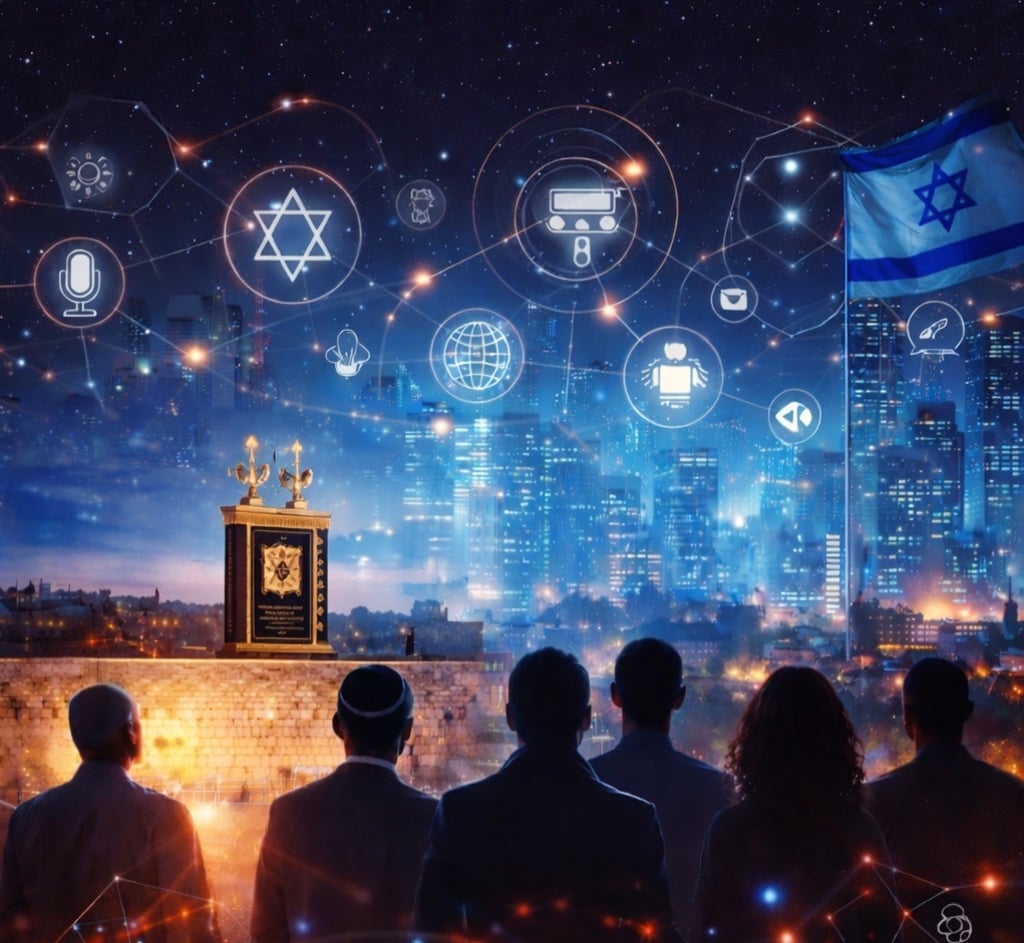
Judaism is now being forced into direct conversation with artificial intelligence, surveillance, automation, and institutional abstraction—questions of agency, dignity, and accountability under non-human systems.
This is genuinely new. No previous era faced machine mediation of human judgment. The central religious question of this century may therefore not be belief, but this: Who remains answerable when systems act?
There is no central rabbinate. No dominant institution. Authority is distributed across podcasts, Substack essays, WhatsApp groups, micro-communities, and independent teachers. Judaism increasingly moves through networks rather than hierarchies.
Influence now travels laterally, not vertically—and often faster than institutions can respond.
The Holocaust shaped Jewish identity through trauma and remembrance. The 21st century increasingly asks a different question: What do Jews now do with power, survival, and continuity? Memory is giving way to ethical agency.
In short, if the 20th century was organized around denominations, survival, and statehood, the 21st century is being organized around responsibility under power, Judaism beyond institutions, Israel as lived civilization, technology as moral disruptor, and networked identity rather than inherited affiliation.
And unlike the last century, there is no single commanding movement.
This century belongs to framework builders, not founders of denominations.
contact@pitchononline.com
© 2025. Moshe Pitchon. All rights reserved.